Filter the hospitals we profile by city, type of care and what each one publishes for patients from abroad — its booking line, its languages and whether it bills insurers directly. Every fact shows the official page it came from and the date we read it.
rated Grade III, Class A, the highest official grade[1]
36
profiled here so far, in 5 cities — 36 have international services listed in hospital or government sources
38
hospitals named on the official pilot lists shown below — 20 of them profiled here
Find a hospital in China
36 hospital profiles so far, listed alphabetically. A hospital is added only once its information is sourced. Combine the filters; each card shows what the hospital itself publishes.
City
Type of care
Language the hospital names
For patients from abroad
Hospital type
Showing all 36 hospitals.
Types of care are grouped by us from each hospital’s official department list; a listed department shows what the hospital lists, not that a particular treatment is offered to international patients. A language or a booking line counts only when the hospital or a government directory names it — a hospital that is not shown may still offer it, so ask.
No hospital we profile matches all of these filters. or tell us what you need and a person on our team will look for you.
How to contact a hospital or book
You do not need ChinaMedMap to reach a hospital. Each hospital below publishes its own channel; the table copies it from the official page cited on the profile.
Contact the international unit, not the general line. It handles booking for patients from abroad, and it is the unit that can say whether the department you need will see you.
Send your records first. A doctor’s summary and recent reports, in English or Chinese. Ask whether the unit will look at them before you travel. See preparing your medical records.
Get the answer in writing. The date, the department, how you will pay and whether your insurer is billed directly — before you book flights. See planning a medical trip to China.
Booking channels the 36 hospitals publish for international patients — sources on each hospital's profile, read on the date shown
+86 189 2210 6862Published for the unit · Working days 08:00–12:00 and 14:30–17:30
Not stated on the pages we read
Not stated
23 September 2026
Phone numbers and hours change. Confirm on the hospital's own website, linked from each profile, before you rely on one. “Not stated” means the pages we read are silent, not that the service is unavailable.
Would you rather have help? Tell us what you need and a person on our team contacts the hospital’s international unit for you, with your consent. How it works.
Hospitals named in official international-medical pilots
China has no single national list of hospitals approved for patients from abroad. Cities and provinces name pilot hospitals instead. These are the lists we have been able to read in full. A place on a list is a government designation, not a ranking, and it does not tell you whether a hospital suits your condition.
Shanghai: Shanghai public hospital international medical tourism pilot — 13 hospitals, announced 19 September 2024[2],[3]Announced at a Shanghai municipal review meeting of the pilot
Guangdong: First Guangdong international medical service pilot hospitals — 25 hospitals, announced 27 March 2026[4],[5]Guangdong Provincial Health Commission, with the provincial healthcare security and drug administrations
The Chinese name is the one in the source. For a hospital we profile, the English name is the one on its profile, with its source. For the others the English name is our rendering, given for orientation; it has not been checked against the hospital’s official English name.
Beijing. Twelve public hospitals were named in 2023. By July 2024, Beijing Daily counted 17 institutions approved to pilot international medical services — 12 public and 5 private. The pages we read do not give the full list.[6],[7] Named in the sources we read and profiled here: Beijing Tsinghua Changgung Hospital.
Shenzhen. The city said in 2024 that it would choose ten hospitals with many patients from abroad. The page we read does not name them.[8]
Our guide to medical tourism in China explains these programmes and the national measures behind them.
Why the choice of hospital matters
China had 38,710 hospitals at the end of 2024.[1] From abroad, finding a hospital is rarely the hard part. The hard part is finding the department and the doctors who deal with your condition, inside a hospital that is set up to receive patients from other countries. Three things get in the way.
A hospital’s name says little about one department
A large general hospital lists dozens of departments — our profiles record up to 79 for a single hospital — and its international unit may not arrange all of them. Start from the department you need, then look at the hospital.
Most of the detail is published in Chinese
Of the 113 official hospital pages cited on this site, 89 are in Chinese. An English home page does not mean the department list, the booking rules or the price notice behind it are in English.
A claim is only as good as its source
Each fact on our profiles shows the official page it came from and the date we read it. Where the official pages are silent, the profile says “not yet confirmed” rather than guessing.
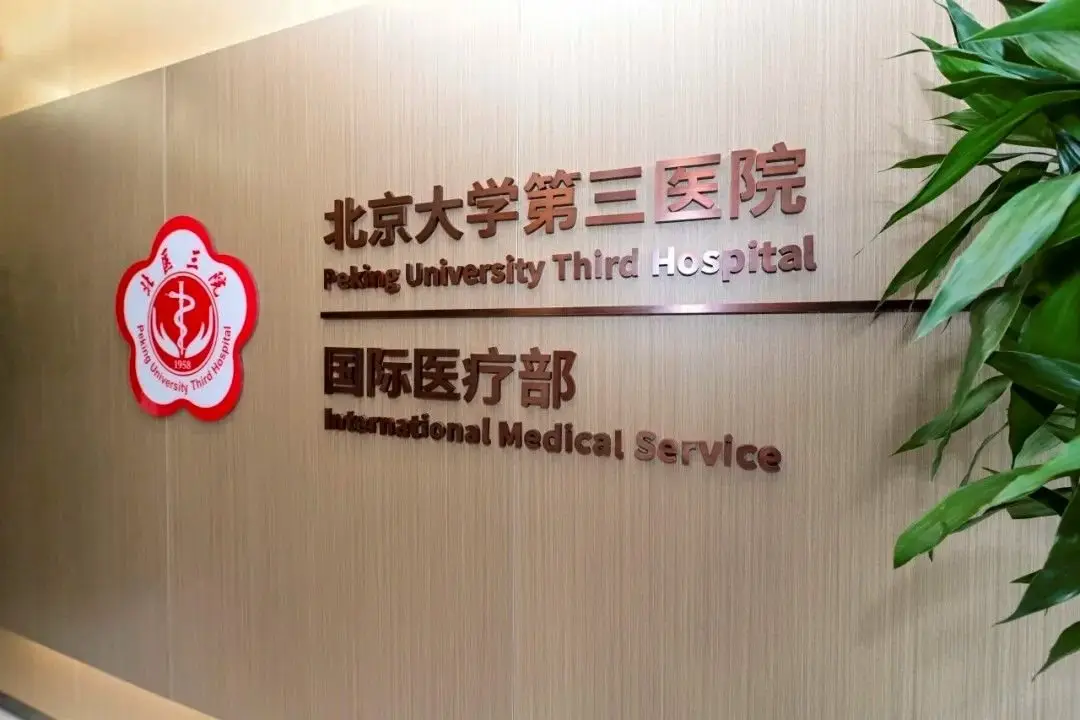
The sign of the international department at Peking University Third Hospital. Many large public hospitals run a unit like this alongside their general service.
International hospitals and international departments in China
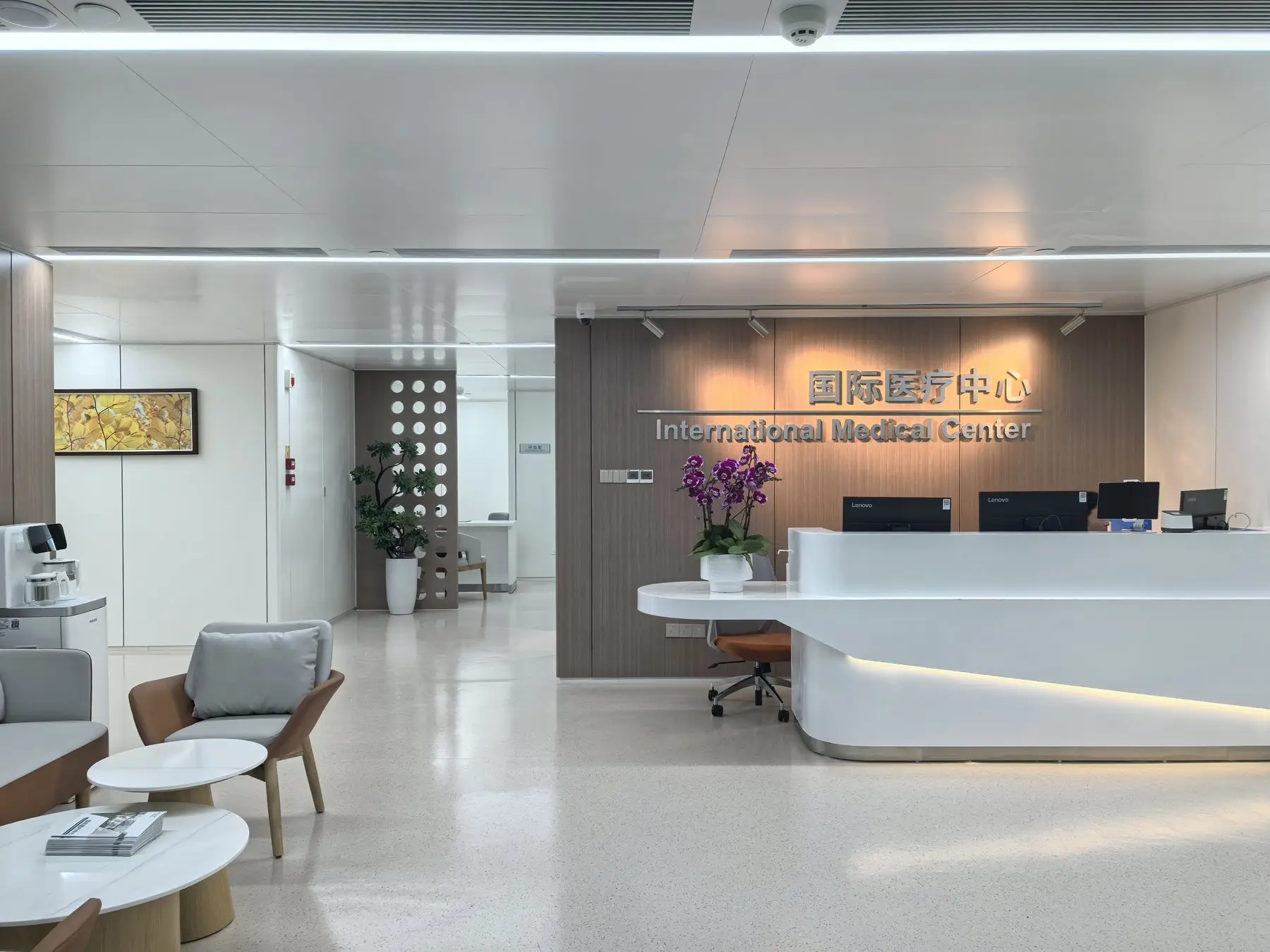
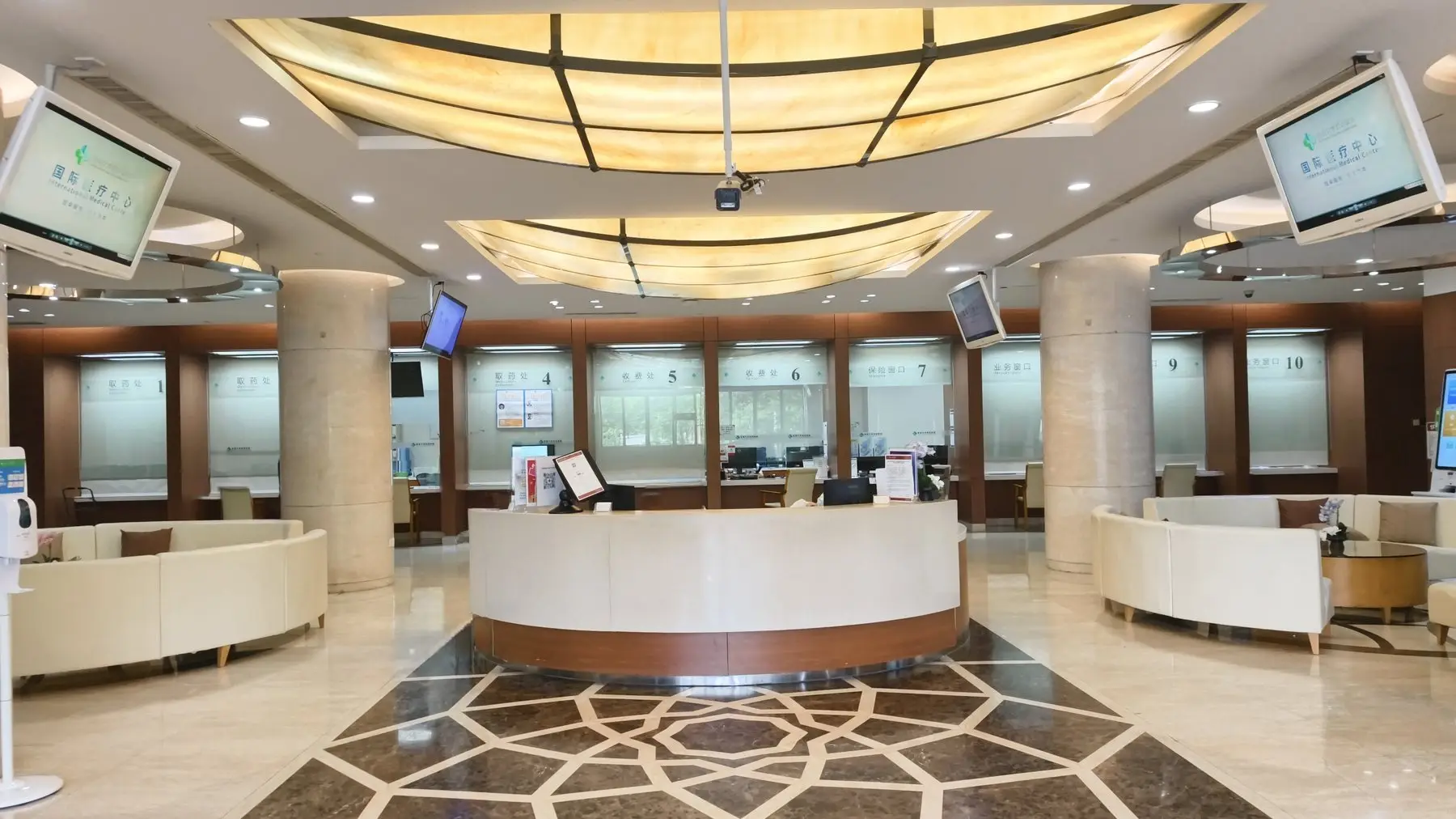
Many large public hospitals run an international medical department (国际医疗部) or a special-needs clinic (特需门诊) alongside their general service. What these units offer varies by hospital. National policy limits special services to no more than 10% of a public hospital's total medical services, so capacity is limited.[9]
What official sources list for the 36 hospitals we profile
36 of 36have international or special-service listings
19 of 36state that they bill commercial insurers directly
23 of 36state which languages they work in
0 of 36state whether they review your records before you travel
Counts reflect the current directory, updated 28 October 2026. Each profile retains its own source dates. A hospital that does not state something may still offer it — it has not said so on the pages we read, so ask its international unit before you travel.
The contact and booking table above lists each hospital’s international unit, the phone it publishes, the languages it names and whether it states direct billing.
Types of care at the hospitals we profile
Each hospital publishes its own department list. We group those departments into 13 types of care, so that you can start from what you need rather than from a hospital name. A listed department shows what the hospital lists, not that a particular treatment is offered to international patients.
Departments listed by the 36 hospitals we profile, grouped by type of care
Type of care
Departments hospitals list most often
Hospitals
Health check-ups
Health Check-up Center · Cancer Screening and Health Management Center · Health Check-ups
People often look for the “best” or “top” hospitals in China, but the right hospital depends on your medical needs — the department, the doctors and whether it can look after international patients. Tell us your needs and a person on our team matches you with hospitals that fit. The official yardstick for a hospital's overall level is its grade: Grade III, Class A (三级甲等) is the highest tier in China's grading system, explained below. At the end of 2024, 1,876 hospitals held it.[1]
A top grade does not make a hospital the right one for your condition, and it does not tell you whether the hospital can look after patients who do not speak Chinese. Check the international department on each profile.
How hospitals in China are graded
Chinese hospitals are graded by function and scale. Grade I hospitals are primary and community facilities, Grade II hospitals serve a wider district, and Grade III hospitals provide high-level specialist care across a region and carry out teaching and research.[10] Within a grade, hospitals are assigned a class through periodic accreditation. In practice, Grade III, Class A (三级甲等, often shortened to 三甲) is the top tier; accreditation is organised by provincial health authorities against national standards that are revised every few years.[11],[12]
A grade describes a hospital's scale and scope. It is not a judgement about any individual doctor or treatment, and it does not tell you whether the hospital can serve patients who do not speak Chinese.
Public and private hospitals in China
By number, most hospitals in China are private: at the end of 2024 the country had 11,754 public and 26,956 private hospitals.[1] China also has foreign-invested hospitals and clinics, and since late 2024 has been piloting wholly foreign-owned hospitals in nine cities and regions.[13] Our guide to healthcare in China for foreigners compares the three usual routes — general outpatient care, a public hospital's international department and a private hospital.
Hospitals in China for foreigners: how access works
Foreign patients can be seen at public hospitals, in their international or special-needs departments, and at private and foreign-invested facilities. An official of the National Health Commission has said that foreign patients seen in international departments pay by commercial insurance or out of pocket, not through China's public medical insurance.[14] Registration is done with your passport, and appointment channels, deposits and direct billing differ from hospital to hospital — each profile above records what hospital or government sources state.
How to evaluate a hospital from abroad
Five questions to ask the hospital
Does it have an international or special-service department? Check the hospital’s website or a government international medical guide.
Which languages are actually supported? An English web page does not guarantee an English-speaking clinician. Ask.
How do you book and pay? Ask about appointment channels, deposits, accepted cards and whether your insurer has a direct-billing agreement.
Will they review your records first? Some departments will look at records before you travel; many will not. We mark this per hospital.
Which campus? Large hospitals have several campuses, sometimes far apart. The international department is often on only one of them.
Three checks on any claim about a hospital
Who says so? A hospital's own website or a health authority's document is a source. A directory, an agent or an advertisement repeating the claim is not — including this site, which is why every fact here links to where it came from.
When was it true? Departments move, phone numbers change and insurer agreements end. Look for a date. Our sources list shows when each page was read.
Is it a fact or a promise? A department, an address and a published price can be checked. A promised result cannot. ChinaMedMap does not rank clinical quality or promise an outcome. Moderated patient experiences describe service, not treatment effectiveness.
The department, not only the hospital. Know which department you are asking for and which campus it is on. Each profile lists the departments the hospital publishes and its campuses.
Your medical records. A doctor's summary, recent test, pathology and imaging reports with the image files, and a list of your medicines. Ask the hospital which languages it accepts. See preparing your medical records.
Entry and length of stay. Agree the treatment with the hospital first, then check which entry route covers medical treatment and the time the hospital expects you to need. See planning a medical trip to China.
Confirmation from the hospital. Ask the international unit to confirm that it can see you, how to book and how you will pay, before you fix your dates.
If you would like help
How ChinaMedMap’s matching works
You can use this directory without contacting us at all: every profile gives the hospital's own website and published contact details. If you would rather have help, this is what happens.
Tell us your needs
Your diagnosis or symptoms, the treatment you have had so far and what you hope for. The request goes to a person, not an algorithm.
A person reviews it
We look for hospitals, departments and doctors that may fit — only among licensed institutions whose identity we have confirmed from official sources.
You get a reply
With the providers that may fit, or an honest answer if we cannot suggest one. Nothing is shared with a hospital until you agree.
The hospital decides
A match is a suggestion, not an admission or a diagnosis. Whether to see you, and how to treat you, is decided by the hospital and its doctors.
Every provider on ChinaMedMap carries a type tag. In China, no organisation or individual may diagnose or treat patients without a Medical Institution Practising Licence (医疗机构执业许可证) or an official filing.[15] Hospitals and outpatient departments hold a licence. Clinics, including traditional Chinese medicine (TCM) clinics, are opened by filing with the local health authority and may treat patients only within the services they have filed.[16]
TCM health-preservation businesses — often called wellness or 养生 centres — are different: they provide non-medical services, and may not diagnose, treat, prescribe medicines or perform procedures such as acupuncture.[17] If you are looking for acupuncture or herbal treatment, use a licensed hospital or a registered clinic. Any wellness centre we list is tagged Wellness.
A Grade III, Class A tag appears only where the hospital or a health authority states the grade on an official page. A licence tag appears only once we have checked the licence or filing number.
What our labels mean
Identity Verified
We checked this provider’s legal identity and basic details against official sources. It is not a judgement of clinical quality.
Contact Confirmed
An authorised contact at the institution confirmed this profile. It does not guarantee that a treatment is available.
International Patient Services Confirmed
The provider confirmed it can currently serve international patients. It does not guarantee acceptance of any individual case.
Partner Provider
ChinaMedMap has a commercial relationship with this provider. Partnership does not mean the provider is clinically better than others.
Sponsored
This placement is paid for. Payment never changes verification labels or medical content.
A profile without a label has been compiled from official sources but not yet verified by our team. See the verification methodology.
Questions about choosing a hospital in China
Answered from what is on this site today. Counts are taken from our own records each time the page is rebuilt.
Is a well-known hospital always the right choice?
No. A hospital's name and grade describe its overall scale, not the department you need or whether its international unit can see you. Start from the department: each profile lists the departments the hospital itself publishes and what it states about its international unit.
Can one hospital cover several types of care?
Often, yes. At least 11 of the 36 hospitals we profile list departments in ten or more of the 13 types of care on this page. That a department is listed does not mean the international unit arranges it for patients from abroad, so ask the hospital about the specific department.
Has ChinaMedMap verified these international departments?
Not yet. Every profile is compiled from the hospital's own pages and from government documents, and each fact shows its source and the date we read it. A verification label is added only after a person on our team has checked the profile; a profile without a label has not been verified by us. See how verification works.
Which cities does the directory cover?
Beijing, Guangzhou, Chengdu, Shanghai and Shenzhen today — 36 hospitals in all. A hospital is added only once its information is sourced, so the list grows gradually rather than all at once.
Is a suggested match the same as being accepted by the hospital?
No. A match is a suggestion from a person on our team of hospitals, departments and doctors that may fit what you told us. The hospital decides whether it can see you, and its doctors decide on diagnosis and treatment.
Does ChinaMedMap give medical advice?
No. ChinaMedMap provides information and matching. It does not diagnose, recommend a treatment or promise a result. See the medical disclaimer.
Do I have to go through ChinaMedMap to contact a hospital?
No. Every profile gives the hospital's official website and the contact details it publishes, and you are free to contact it directly. Our matching is there if you would like a person to help.
Sources
2024年我国卫生健康事业发展统计公报National Health Commission · Chinese · dated 2025-12 · retrieved 21 September 2026
广东首批25家国际医疗服务试点医院亮相Nanfang Net (南方网, Nanfang Media Group) · Chinese · dated 2026-03-31 · retrieved 5 October 2026
港澳人士"北上"就医必看!广东首批25家医院入选Liaison Office of the Central People's Government in the Macao SAR (republishing 大湾区之声) · Chinese · dated 2026-04-01 · retrieved 24 September 2026
北京清华长庚医院获评"北京市国际医疗服务试点机构"Beijing Municipal Health Commission · Chinese · dated 2023-11-03 · retrieved 24 September 2026
北京17家医院试点开展国际医疗服务,收费实行自主定价Beijing Daily (北京日报客户端), carried by Sina · Chinese · dated 2024-07-12 · retrieved 5 October 2026
深圳将首选10家医院开展国际医疗旅游试点Shenzhen Municipal Health Commission · Chinese · dated 2024-04-10 · retrieved 24 September 2026
国办发〔2015〕38号 城市公立医院综合改革试点指导意见 (reprint)State Council General Office (reprinted by Beijing Municipal Government) · Chinese · dated 2015-05-06 · retrieved 21 September 2026
医疗机构管理条例(2022年修订)State Council of the PRC (text published by the Beijing Municipal People's Government) · Chinese · dated 2022-03-29 · retrieved 24 September 2026
国家卫生健康委 国家中医药局关于印发诊所备案管理暂行办法的通知National Health Commission and National Administration of Traditional Chinese Medicine (State Council Gazette 2023 No. 4) · Chinese · dated 2022-12-20 · retrieved 24 September 2026
国家中医药管理局关于印发中医养生保健服务规范(试行)的通知National Administration of Traditional Chinese Medicine · Chinese · dated 2023-04-26 · retrieved 24 September 2026
Tell us what you need. A person on our team reviews every request and replies with providers that may fit. We share your details with a provider only after you agree.